M. H.
The author has lived in and worked in Southeast Asia for fourteen years.
Mission Round Table 19:3 (Sept-Dec 2024): 25-27
To read articles in this edition, visit this post on Mission Round Table 19:3.
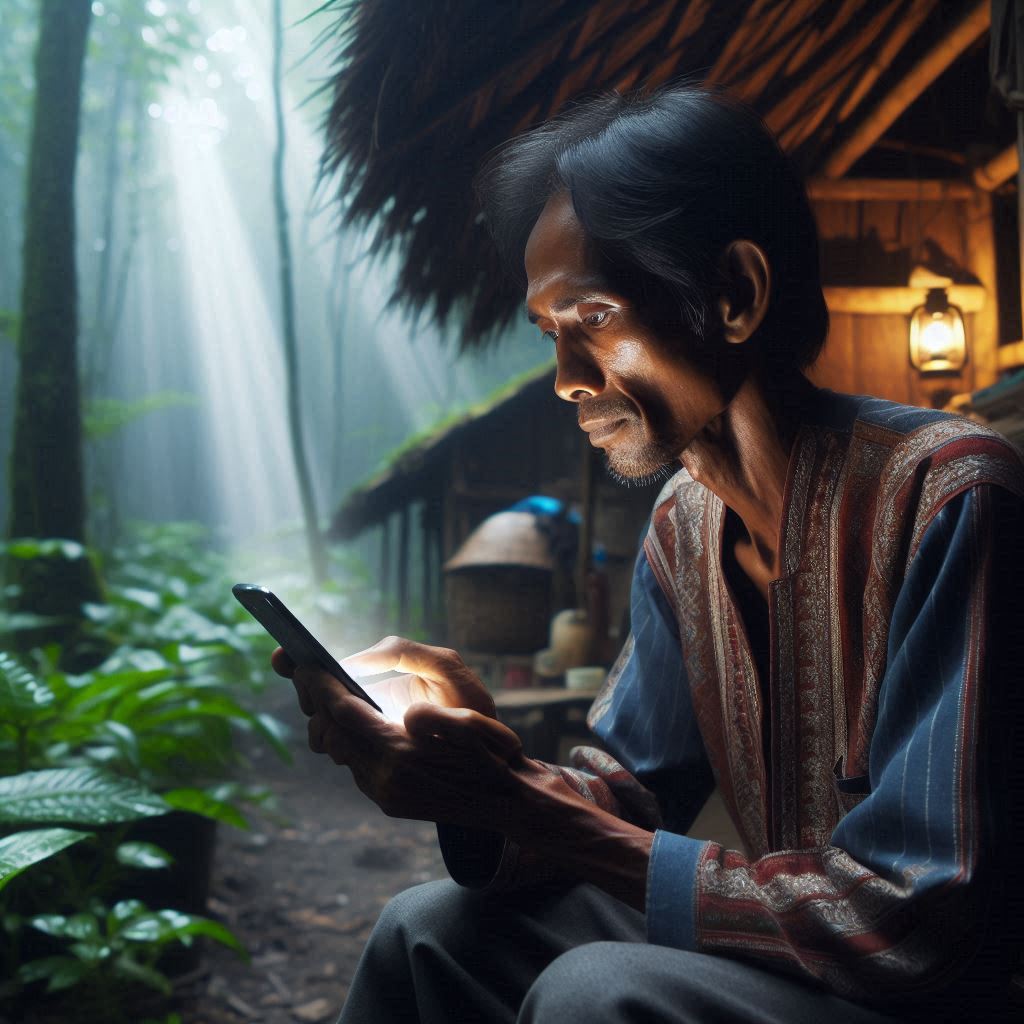
The idea of missionaries going overseas to live in a hut in the middle of a jungle and meet with technologically inferior tribal communities is an antiquated picture that does not reflect our present reality. While the man living in a hut with dirt floors in the middle of the jungle may still exist, it’s likely that he has a Facebook account, watches TikTok and YouTube videos, and consumes hours of digital content daily. I have seen this reality play out firsthand as our family visited a series of seven villages deep in a jungle of Southeast Asia that are only accessible by boat along a river. Yet each village has access to a government-supplied solar-powered charging station. In these villages, a new daily ritual has been born. Nearly all the villagers use the power station to charge their cell phones. How are mission teams to respond when even the most remote villages of traditionally homogeneous societies that used to be governed by local wisdom are now rejecting local traditions and practices for the information and social networking that is available to them through their phones? We must ask ourselves the question of how the global mission landscape is changing to accommodate the technological and social-network explosion captivating the hearts and minds of this present generation.
When we stop our busyness and survey those around us, we can almost be guaranteed that someone in our vicinity is connected to some sort of device. In the past ten years, the global population of mankind has been eclipsed by the number of mobile phones that exist on the planet. As of 2024, there are approximately 8.31 billion mobile phones actively in use worldwide.[1] This number is expected to continue to grow rapidly, with projections indicating that the total number of mobile devices could reach 18.22 billion in 2025.[2] It’s not just the staggering numbers of devices, but the fact that each of these devices is being used for many hours every day that causes us to question how missionary endeavors are being impacted. These devices are constantly notifying us, vying for our attention, and captivating our eyes, ears, and minds.
The Apostle Paul sought to “become all things to all men, that by all possible means he might win some” (1 Cor 9:22). This verse is foundational to the concept of contextualizing the models we use to communicate the gospel message. To contextualize the gospel is not to change its message, but to communicate the message in a way that is relevant to each unique culture. In today’s socially connected world, becoming all things to all men means meeting people where they are and presenting a message that they can relate to. It should come as no surprise that “where people are” is online.
The global average of time spent online daily is 6 hours and 54 minutes, but the Southeast Asian countries of Malaysia, Indonesia, the Philippines, and Thailand all fall within the top 10 internet consumers globally, with the average daily time in the Philippines exceeding 11 hours per day.[3] When a society has changed so drastically that they are spending a majority of their waking hours consuming digital content, we must ask ourselves why there aren’t more workers entering this digital space to meet people and find opportunities to share the gospel, especially when we know people are searching online for answers to life’s big questions?
Rather than missionaries holding onto traditional models of outreach and church planting, some mission teams are adapting their strategies to make use of media to sow the gospel broadly. So, what does this change look like practically and what is the advantage of adapting a media outreach strategy? One model that we are currently employing makes use of a media support team made up of foreign missionaries and local believers who see this as their primary role in missions to facilitate wide gospel sowing. By building a partnership between our media support team and local field teams, we are more able to engage huge population segments where we can find those who are open to the good news.
The idea behind wide gospel sowing—defined in terms of hundreds or even thousands of people hearing the gospel daily—has been around for quite some time. However, our current digital age presents us with an outstanding opportunity to sow the gospel broadly online, especially where it can contact soil that is often considered out of the reach of traditional evangelism. By partnering with local believers, our media support team creates regionally based social media posts and advertisements that address the felt needs and spiritual needs of the unreached focus people. These social media advertisements usually ask a question designed to stoke questions that already exist in the minds of our focused segment of society. Using the local language, these advertisements might ask: “Do the sins of your past cause problems in your life?” or “How can you experience true forgiveness?” or “Do you want to know God’s plan for marriage?” or “Do you want to find God’s straight path to heaven?”
You can’t “unthink” a question. As our focus people are scrolling through their social media feeds, we have about one second of each person’s attention to look at the advertisement, read the question, and determine its relevance for their lives. Our goal is that our online advertisements pique the curiosity of the reader to the point that they want to reach out to us for answers. Connected to each of our advertisements is a button with an invitation to chat with a local believer in order to get help with their questions.
In the past four years, we have seen over 30,000 non-believers respond to these felt-needs-based advertisements and initiate chat conversations with our local teams on the ground in Southeast Asia. Non-believers are actually “reaching out” to our mission teams as they seek help to life’s problems! Our missionaries are currently partnering with more than seventy volunteers and local staff who are taking on the role of a Digital Responder. A Digital Responder is a local believer who chats with non-believers with the goal of sharing the hope we have in Jesus Christ. Digital Responders will chat online with anyone who wants to find forgiveness of sins and hear God’s plan of salvation as it relates to their particular felt need. Through this ministry, these Digital Responders are being strengthened in their faith and sharpened in their gospel witness as they boldly proclaim Jesus and show his love and care to everyone they encounter online.
The role of the foreign missionary in this ministry looks quite a bit different than the traditional model of a front-line worker. Every morning, I step into the mission field, but probably not as you would expect. My daily routine is to wake up early in the Midwest of America. I make a large cup of coffee and start up Zoom, often still wearing my pajamas. As the sun sets in Southeast Asia and rises in America, one out of our nine field teams of local believers currently running a media outreach strategy joins me on Zoom for our weekly meeting during which we pray and discuss strategy for the wide gospel-sowing outreach via Facebook, Instagram, TikTok, or Google Searches. It is extremely important for the foreign missionary to learn the target culture and language to be able to coach teams well, but once the foreign missionary has a good grasp of this, the media support role can be done from virtually anywhere in the world.
As we share the gospel broadly, each of the nine local teams responds to 25–50 new online contacts every day. Collectively that means that we are having between 225–450 new conversations with non-believers every day! As the online conversations develop, the non-believing contacts open up about their needs and desire for a relationship with God. We have seen that there is a huge advantage to chatting in an online conversation as non-believers are much more open to sharing deep strongholds of sin with us in an online environment.
Every day, we chat with people about very private issues. This is especially true for those from an honor-shame context. In this online environment, non-believers are opening up with us about sins that they have kept hidden from their family, friends, neighbors, and local religious leaders. We chat daily with people involved in adulterous relationships, trapped in debt and poverty, plagued with addictions, suffering life-threatening illnesses, incarcerated for crimes committed, or held captive by various other sins. Often, I view this, not as a media ministry, but rather a ministry of compassion and freedom for those who are hurting from the pain of sin. “The Spirit of the Sovereign Lord is on me, because the Lord has anointed me to proclaim good news to the poor. He has sent me to bind up the brokenhearted, to proclaim freedom for the captives and release from darkness for the prisoners” (Isaiah 61:1). Somehow, these non-believers find the online environment to be a safe place where they can be honest and vulnerable about the pain of their sins without facing the shameful repercussions of having their private sins exposed to their closest relationships.
On numerous occasions, our local believing partners have shared that they have never had conversations so deep with a non-believer in their face-to-face models of outreach. Throughout each online chat, our local partners show empathy while at the same time directing the conversation towards the forgiveness and salvation that can be found only in Jesus. Through this compassionate dialoguing, our field teams are daily identifying between one and ten seekers who are open to exploring Jesus as God’s provision for their sins!
Once a seeker is identified through the chat conversation, we invite them to begin studying the Bible with our local teams either online or in person. This media outreach strategy is not intended to stay completely online. The whole trajectory of this ministry is to identify spiritually open people among the masses who respond positively to the gospel and encourage local believers to begin meeting with them face-to-face. Usually, the goal of the first face-to-face meeting is to invite the seeker into a saving relationship with Christ through faith and enter into fellowship with other believers in Christ.
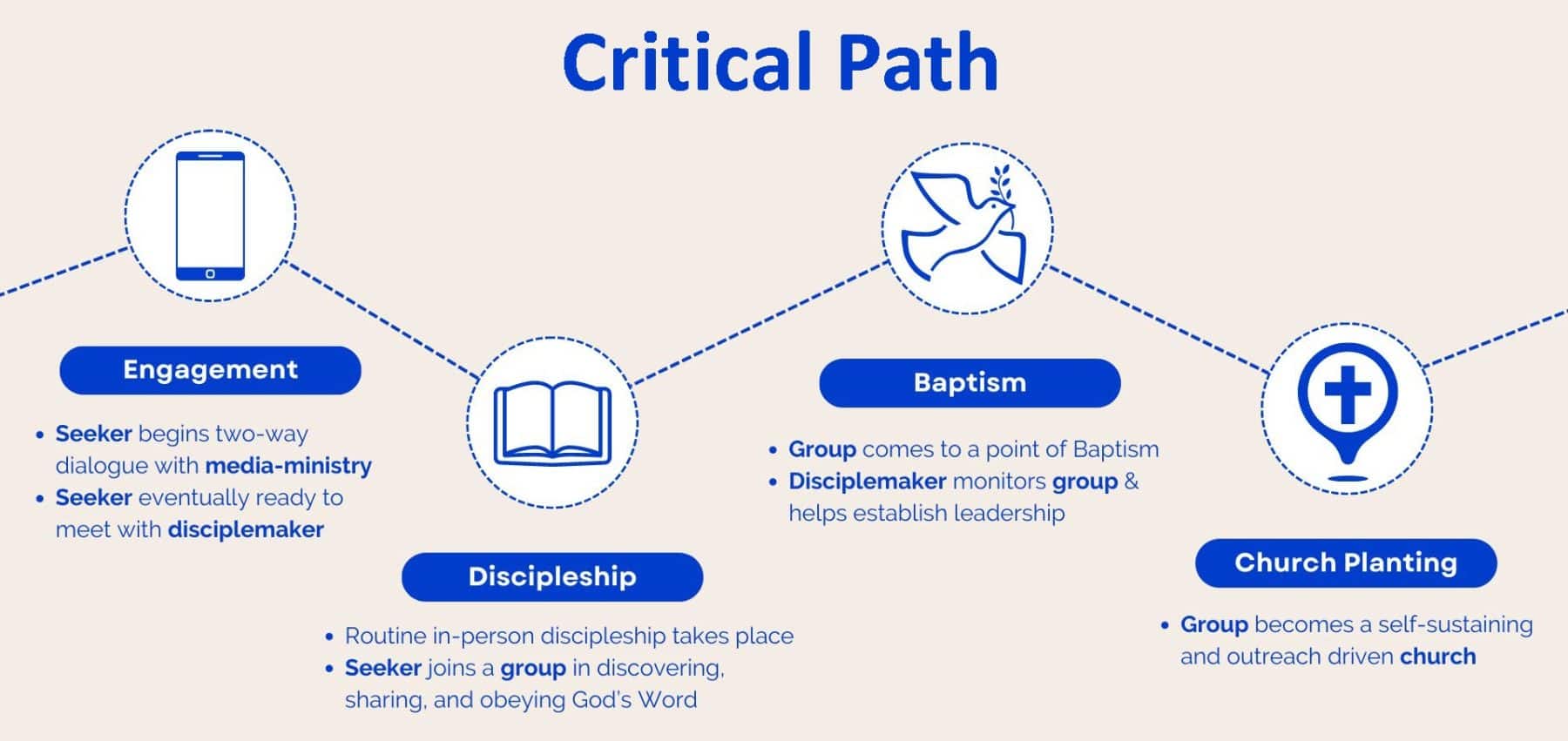
While this strategy has proved to be fruitful in allowing our field teams to engage with many non-believers, we recognize that it is through the work of the Holy Spirit and our prayers that the Father draws people to Christ! The most fruitful of our nine teams is the one that focuses more on prayer than strategy! One of the major prayer needs for each field team is boldness and wisdom to know when and how to move these amazing online conversations into face-to-face meetings.
We are facing another challenge and blessing in this ministry. Because we can reach out to people throughout an entire province or country, sometimes we see people come to faith in locations that are several hours from any other believer. This is a true blessing, but how are we to disciple multiple people spread throughout a province when we only have a single mission team on the ground there? Truly, “The harvest is plentiful, but the workers are few” (Matt 9:37–38). Please join us in praying for God’s provision of more co-laborers! Even though our teams may be far away from these new believers, we have developed two solutions that help us face this challenge. First, we find that this opens up the door for our teams to network with other believing groups who might live in closer proximity to the new believers. Secondly, this creates an opportunity for our field teams to use media not only as an evangelistic tool, but also as a tool for ongoing discipleship at a distance.
When it is not possible for our field teams to network with other mission-minded believers, they are encouraged to visit new believers in person at least once a month. They are, however, told that the primary source of discipleship for some will consist of online interaction through phone calls, text messages, voice recordings, audio clips of Bible teaching, and contextually sensitive teaching videos designed for new believers. One new tool we are developing is the ability to use Artificial Intelligence to take a pre-recorded teaching video and perform a face-swap and voice-swap of the local teacher sharing biblical truth. This face-swap technology protects their identity from religious or political groups that might want to harm them for teaching about Jesus. When most of the discipleship happens over WhatsApp, Line, text, or Zoom, we encourage our field teams to try to interact daily with each seeker/new believer in this virtual discipleship. Face-to-face visits are still by far the best option for growth in Christ, but our media support team is striving to facilitate discipleship at a distance when circumstances make it too difficult to meet in person.
Truly, the landscape of missions has already changed and the methods of evangelism and discipleship that existed even ten years ago must undergo scrutiny as to their effectiveness in this new digital world. Mission teams around the world must wrestle with how they might adapt their strategies to include media use. As we see new believers coming to faith, we can’t help but to praise God for giving us this unique window in time and the tools relevant to this generation to bring the good news of Jesus Christ into places where it has never been preached. We invite you to pray that the faith of each new believer will be protected and multiplied as they continue to live in their original social network. We also invite you to prayerfully consider how these new methods of evangelism and discipleship might be incorporated into your current mission strategies in this new digital world.
[1] Ash Turner, “How Many Smartphones Are in the World? (2024),” BankMyCell (blog), updated 24 May 2024, https://www.bankmycell.com/blog/how-many-phones-are-in-the-world (accessed 28 October 2024).
[2] “Forecast Number of Mobile Devices Worldwide from 2020 to 2025 (in billions),” Statista, April 2021, https://www.statista.com/statistics/245501/multiple-mobile-device-ownership-worldwide/ (accessed 28 October 2024).
[3] Kristie Neo, “Southeast Asia: Digital Life Intensified,” We are Social (blog), 8 March 2021, https://wearesocial.com/sg/blog/2021/03/southeast-asia-digital-life-intensified/ (accessed 28 October 2024).