Issues and Influences of Digital Technology on Gen Z Communication, Relationship, and Community from a Missiological Perspective
 Scott Brown
Scott is the Communications Lead at OMF Australia, bringing a wide range of experience from both the for-profit and non-profit sectors. Since joining OMF in 2019 and becoming a member in 2024, he has developed a passion for using video to tell stories that inspire and support mission work. Scott also leads “Creatives,” a Gen Z community of volunteer content creators, helping them use their talents for mission. He holds degrees in Business and eBusiness and Communication from Swinburne University and is currently studying Missional Leadership. Scott also serves part-time with Media for Movements, loves coffee, and enjoys roasting his own beans. He has been married to Ruth for twenty years. Together, they have two daughters, Alicia (11) and Hope (9).
Mission Round Table 19:3 (Sept-Dec 2024): 28-35
To read articles in this edition, visit this post on Mission Round Table 19:3.
Synopsis
Gen Z represents a unique and digitally connected generation. Born between 1995 and 2010, they are profoundly shaped by rapid technological advancements and significant global events. Gen Z also demonstrate a digital-first approach to communication and community, enabling them to have a global perspective and effectively mobilise for causes they care about.
Gen Z values diversity and inclusivity. They are also committed to justice and environmental concerns. These values are influenced by their educational experiences and don’t always align with certain aspects of biblical morality and the Great Commission.[1]
Their preferred modes of communication and engagement include digital platforms like TikTok and YouTube, which have transformed their learning and social interaction preferences. However, constant digital connectivity removes the social cues present in face-to-face interactions that help people better understand one another, negatively impacting empathy toward others.
For the church and mission organizations aiming to engage with Gen Z, adapting to their digital world is essential. They must create an online presence that aligns with Gen Z’s preference for curation and collaboration, while also exploring opportunities for them to make a meaningful impact. It’s important that Gen Z, the church, and mission organizations use digital technology in a way that supports, rather than hinders, deeper relationships and spiritual growth.
In a rapidly evolving world, the church and mission organizations must consider how shifting generational and cultural landscapes will shape the future of mission. Understanding and effectively engaging with Gen Z is a crucial aspect of this ongoing process.
Introduction
Cultural indicators
As a university marketing student in the mid-1990s, the very first principle I was taught was that “you cannot be all things to all people.” Companies understand that their products won’t appeal to everyone, therefore they define a target audience and invest in marketing research to better understand how to reach and persuade them.
However, in 1 Corinthians 9:22, the Apostle Paul boldly proclaims that he has “become all things to all people so that by all possible means I (he) might save some.” If the mandate of the church and its body of believers is to evangelise all people and make disciples of all cultures, we must also be willing to venture into other cultural spaces different from our own.[2]
In an era defined by vast information and globalization, generational changes reveal significant cultural shifts as people’s lives are shaped by iconic products and transformative historical events.

Gen Z has firmly established itself as a defining generation. Unlike Gen Y, who are also known as Millennials, the label “Gen Z” has become the most widely accepted term for this group. According to Google search trends, “Gen Z” accounts for 63 percent of searches, while alternative terms like “post-Millennial” and “iGeneration” lag far behind at only 1 and 2 percent, respectively.[3]
With at least 27 percent having entered the workforce in Australia, Gen Z is already having a global impact on economies and societies. Big business is increasingly aware of this and has invested in research to improve their chances of selling their products or recruiting them for their workforce.
As a Gen X communications professional, I’m learning that to engage Gen Z effectively requires more than just digital tools; it requires a deeper comprehension of how they connect, communicate, and form relationships. This research aims to equip mission organizations to effectively disciple and mobilize this generation by understanding how to adapt to their values and social dynamics in a biblically sound way.[4]
Hypothesis
Like previous generations of the information age,[5] Gen Z social structures (which are not always geographical or monistic) have been profoundly influenced by digital technology. Therefore, this research has been guided by the following hypothesis formed from anecdotal observations:
Digital Technology as a cultural good has influenced and shaped the way Generation Z engages in communication, relationship, and community.
This hypothesis will be carefully examined using the following socio-cultural framework:
What’s going on: A brief timeline of generations and influential historical markers affecting the information age; general insights of Gen Z culture; and digital technology behaviours and statistical research.
Why is this happening: A more in-depth cultural analysis of Gen Z’s digital culture; a summary of the sociological relationships within this culture; and the benefits and challenges they face.
The purpose of this research is to determine how church and mission organisations can effectively reach and engage Gen Z with the gospel and mission. Furthermore, what can the church and cross-cultural mission agencies such as OMF learn from this research to:
- Effectively mobilise and prepare Gen Z for cross-cultural mission.
- Uncover new opportunities and people groups for contextualizing the gospel and effective discipleship.
Defining Characteristics
Gen Z
McCrindle defines the term generation as individuals born within a specified time-period, characterised by shared events, social markers, and emerging technologies. Although the baby boomer generation spans twenty years after World War 2 (1945–1965), generation gaps for X, Y, Z, and Alpha have often been reduced to fifteen to reflect the flow of social change (see Fig. 1). However, those who accept generational labels often disagree on the specific years or traits, with researchers and commentators interpreting them differently. Generational boundaries tend to be more fluid and context-dependent than fixed labels suggest.[6]
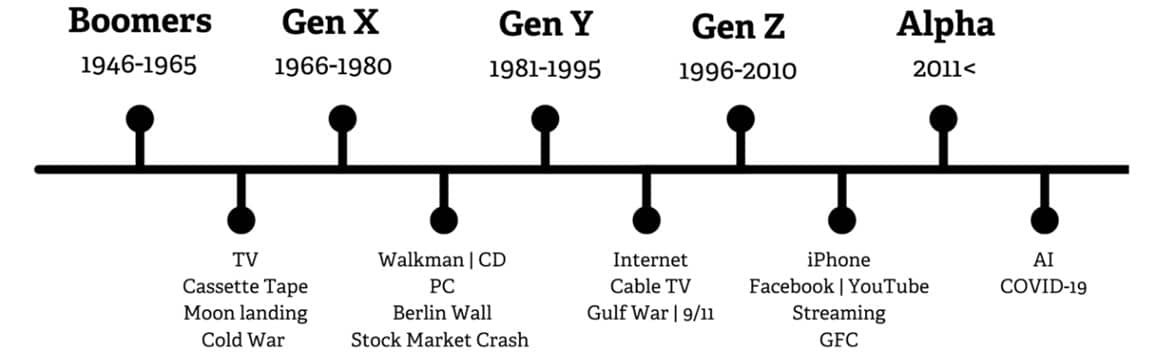
Whilst generations X and Y grew up in the shadow of the collapse of communism, the Iraq and Afghan wars, and the aftermath of 9/11, Gen Z are navigating similar upheavals. These experiences may appear similar at first glance; however, the nuances within each event’s circumstances influence generations in distinct ways. For example, the pandemic has helped shape a work-from-home culture, while rapidly evolving technologies like AI are accelerating automation, potentially at the expense of creativity. Each of these developments plays a role in shaping Gen Z’s worldview and their responses to the challenges they face.[7]
The connected generation
Gen Z’s collective identity through community and relationship has been heavily influenced by rapid development of technology and innovation—high bandwidth and the invention of the smartphone (iPhone) in 2007 brought greater connectedness. All this is shaping their worldview as culture, perspectives, and shared experiences are transmitted rapidly.
Data from the Institute of Business Management reveals more than 74 percent of Gen Z say they spend their free time online.[8]
Although the pandemic accelerated the push towards greater digital fluency, “Our World in Data” reveals this trend began much earlier—between 2010 and 2016, 640,000 people per day were online for the first time.[9]

Greater connectivity has also created a more pluralistic world where work, social, and family life can coexist in the same space and time. McKinsey research revealed that Gen Z have come to value online community because it enables them to connect and mobilise around interests and causes. This, in turn, has created a digital-first mindset where community and relationship in the digital space is of equal value to the physical.
Education and learning styles have also shifted. Mark Prensky coined the term “digital native” alongside “digital immigrant” to describe those who have grown up surrounded by the rapid dissemination of technology. He argues that when a student is motivated to learn something, they have on-line tools that far exceed what a teacher can provide.[10]
Religion, values, and worldview
The Varkey Foundation’s 2017 Global Citizenship Survey found religion is no longer a sacred canopy for Gen Z—less than half (42 percent) agree it was important. However, they are radically diverse, inclusive, and are concerned about justice and the environment. McCrindle research in Australia found that 46 percent of their consumer purchasing is influenced by the product’s manufacturer’s values on social responsibility, including issues such as environmental sustainability. Furthermore, McKinsey’s global survey revealed that 68 percent of Gen Z expect brands to contribute to society by promoting issues such as diversity and fair labour practices. Despite their emphasis on social conscience, 80 percent of Gen Z in Australia also demonstrate individualistic tendencies, prioritising financial freedom and personal success.[11]
Gen Z’s values have been significantly shaped by their education, including the content they’re learning and engaging with. McCrindle research found that Gen Z Australians are 2 to 3 times more likely to have learned through education about cultural inclusivity and the environment than baby boomers. The number is nearly 9 times more likely for gender identity and fluidity—an issue even (77 percent of) Gen Y consider confronting. However, Gen Z views will likely continue to be shaped through time and intervening global events.[12]
For Gen Z, acceptance as a value is no longer only about respect, even when there is disagreement. It increasingly involves accepting, or even affirming, the worldviews of others. In fact, Barna Group reports that half of practicing Millennial Christians (47 percent) “agree at least somewhat that it is wrong to share one’s personal beliefs with someone of a different faith in hopes that they will one day share the same faith.” Whilst Gen Z were not included in this study, it’s anticipated their views will be amplified on this stance.[13]
These Gen Z characteristics are a global trend and perhaps indicative of a distinct cultural people group. Twenge’s research concluded that, unlike previous generations, Gen Z demonstrates similarities across gender, race, location, and socio-economic status. Further sociological research also revealed that the stimulation and development experiences of digital natives affects their logical reasoning and thought processes in similar ways to people from different cultural backgrounds.[14]
Cultural analysis
Leveraging digital community for social change
Paul Hiebert defines culture as “the integrated system of learned patterns of behaviours, ideas, and products characteristic of a given society.”[15]
Psychologist Edgar Schein developed a model for understanding culture. This model will be used to better understand the constructed identity of Gen Z and their cultural shift towards digital first communities. It consists of three categories:
- Artifacts/Products
- Shared values
- Worldview.[16]
Artifacts/Products
The emergence of new products and innovation has given rise to a previously non-existent vocabulary such as “apps”, “smartphones”, and “tweets”. Gen Z is not only aware of these technological trends but have seamlessly integrated them into their daily lives.

Digital technology has shaped their global perspective and ability to connect with like-minded individuals, re-organise their voice, and advocate for the change they want. It has empowered them to become co-creators and not just collaborators. They also enjoy multi-modal learning styles, not just virtual, and are influenced through forums, not just peers.[17]
Gen Z are eager for “cutting-edge” digital technology, and their learning style reflects this. A full 98 percent have used technology and 80 percent use their smartphone as part of their formal education according to a Dell Technology global survey. Furthermore, 77 percent are willing to be technology leaders in their work or careers.[18]
In Australia, McCrindle Research indicates Gen Z’s preferred platforms for learning new skills are as follows: TikTok (48 percent); YouTube (42 percent); Instagram (46 percent). The figures below compare these preferences to previous generations (See Table 1).[19]

Perhaps one surprising change is the shift away from social media broadcasting. Dell states that 72 percent are careful about what they put on social media as it might affect their employment prospects.[20]
In her book, Cultivate Community, Ashley Lin observed four patterns that have shaped Gen Z’s digital behaviour and the communities they seek to belong to:
- Social media
- Crowdsourcing
- Curation
- Online organising
Social media platforms have made it easier for Gen Z to connect with the people they want. SnapChat and TikTok—41 percent of users are between 16–24—is where many Gen Z (and Gen Alpha) get their first taste of digital connection. In fact, they have also found new ways for older, less popular platforms to meet their needs. Despite being one of the oldest platforms, YouTube remains popular for its ability to collaborate with fellow creators. Facebook (Marketplace) has also gained popularity for buying and selling.[21]
Crowdsourcing is the online collection of information, opinions, and work-for-funds from a group of people, empowering content creatives and collaborators. Examples of crowdsourcing platforms include Airtasker, GoFundMe, and Amazon’s Mechanical Turk.
Curation is the process of selecting and organising information. Until 1900, it was estimated that human knowledge doubled approximately every 100 years. This figure was reduced to 25 years after World War 2 (1945). However, by 2013, it was estimated to double every twelve hours.[22]
In response to overwhelming amounts of information, Gen Z expects to access well researched, reviewed, and editorialised content of interest to them. In a recent study, 36 percent of Generation Z respondents say they “carefully curate” their online presence, compared with 31 percent of millennials. Organisations, influencers, and content creators employ hashtags and Search Engine Optimisation (SEO) to make it easier for their audiences to find them on social media and the web.[23]
Online organising is collecting real life stories that illuminate the issues they want to see change in. Since the creation and demise of the peer-to-peer file sharing platform Napster, emerging generations increasingly see others’ online content available to them as free of ownership or cost. The open-source movement and creative commons is evidence that people will labour for free to benefit strangers. For Gen Z, there’s currency in offering their own or sharing other people’s life experience as it offers compelling social proof for influencing change.
Shared values
Radical inclusion
Gen Z are radically inclusive, aspiring to learn from and work with people who are geographically, culturally, and, arguably, ideologically different from them to create positive change in the world. McKinsey research also revealed that 66 percent of surveyed Gen Zers believe that communities are created by causes and interests, not by economic backgrounds or educational levels.[24]
Digital communication provides them with a global window into lives and issues from vastly different cultures. According to Forbes, 65 percent of Gen Z want to create positive change for the causes they care about. Crowdfunding platforms such as Go Fund Me provide the means to achieve outcomes with greater speed and scaling impact compared with in person community.[25]
Pluralism and connectivity
Devices bring work, school, social media, and entertainment into the same time and space. A Global Web Index survey found that 95 percent of Gen Z use a second device whilst watching TV.[26]
Trust and relationship
For Gen Z, trust facilitates and promotes collaboration and has an important role in building and maintaining social relationships. McCrindle research revealed that 70 percent of Gen Z invest in brands that they trust through reviews (64 percent), friends (58 percent), and influencers (36 percent). According to the global survey by the IBM Institute for Business Value, 61 percent of teens surveyed would feel better sharing personal information with brands if they could trust it was being securely stored and protected.[27]
Another important element of trust for Gen Z is predictability. The current “cancel culture” trend means they are hesitant to broadcast anything that could leave them feeling rejected. This has a profound influence on their views and practices of evangelism and missions.[28]
Worldviews
Barna reports that biblical worldviews have declined with each successive generation since the beginning of the information age. Furthermore, Christian author Jonathan Morrow maintains that Gen Z is growing up in a world that is increasingly rejecting biblical moral values. Instead, they desire a world that has the characteristics that certain biblical principles allow to exist, because they are passionate about social justice, equality, and aid.[29]

In a world where the rapid transmission of information has fuelled fear and uncertainty, Gen Z often wrestles with deep questions and concerns. They are apprehensive about institutions such as religion, Christianity, and mission, as they compare traditional approaches and attitudes with the more progressive societal values of today. Campus ministry groups such as InterVarsity Christian Fellowship (AFES)[30] have responded accordingly. Instead of initiating conversation around doctrine, they begin with questions about church and cultural issues like ethnic diversity, reconciliation, and systematic justice. They have also moved from a model of explaining to a belonging and observance first approach.[31]
Sociological analysis
Cultivating community
Community must provide “a sense of cohesion and good intention.” ~ Fabian Pfortmüller, founder and CEO of the Together Institute
Lin has readapted traditional definitions of community to include “a group of people who build power together through belonging and mutual care.” For Gen Z, the digital space cultivates a sense of belonging, collective power, intentionality, and a willingness to be vulnerable to each other. Research by Tapatalk revealed 64 percent of Gen Z and millennials feel better understood by their online friends than they do by “real-world” friends.[32]
Berger’s Three movements in the social construction of realities provides a framework for explaining how this “digital first” constructed identity of values and behaviours has been formed.[33]
Externalisation is the ongoing, outpouring of human activity, producing new artefacts in the world. For Gen Z, technological production is a primary carrier of cultural goods such as the smartphone, social media, and gaming platforms. These goods are often broadcast and selectively targeted according to their online activity and preferences through mass media. Marketers hope to persuade Gen Z of the benefits these goods will have on their lives, driving up demand.
Technological artifacts such as social media have produced new artifacts such as digital communities. With mass broadcasting channels like Twitter, now X, deemed too risky for Gen Z, Digital Campfires is a name describing a move towards more intimate connections through Discord channels, WhatsApp, or gaming chat groups such as Minecraft. In fact, gaming is not just about entertainment, it’s one of the ways Gen Z connect with friends.
Web 2.0 has also made it possible for more bi-directional conversation and dialog. Customers, members, brands, and communities can externalise their needs or values by interacting with each other, including publicly via social media comments or privately through messenger.
Objectivation is creating systems of meanings from different objects over time. Platforms such as Instagram create their own terms and conditions according to what they believe are acceptable “Community Standards”. In turn, digital communities are formed with rules based around shared values, interests, and curation of knowledge. Furthermore, ratings systems such as TripAdvisor or Apple App Store exist to establish trust. Constant connectivity has also driven the need for efficient systems of communication such as using single letters, abbreviations, or emojis.[34]
Internalisation is the subconscious acceptance of objectivised rules and standards. Digital artefacts such as smartphones and social media have shaped Gen Z’s worldview, therefore they accept the rules and constructs integrating them into their lives.
Sherry Turkle observes a Gen Z trend called the “rule of three”. In this example, when at least three friends raise their heads during dinner, it signals to others that it’s acceptable to lower their attention to their phones. Those with their heads up are expected to editorialise the conversation to the others.[35]
What’s it like?
Gen Z are digital natives born into a world of technological cultural artifacts they did not create. These tools have helped them absorb and curate overwhelming amounts of information and mobilise around the issues and causes they are concerned about with far greater reach.
Biblical worldviews
Gen Z’s secular and biblical values have been significantly shaped by digital communication. Nevertheless, there is evidence that this isn’t the sole carrier. McCrindle Research reveals a correlation between each generation’s worldview and what is learned in educational institutions.[36]
Although they are radically inclusive, the thought of broadcasting opinions to the masses has created fear and anxiety around “cancel culture”. Their worldview doesn’t reflect a collective understanding that the gospel is radically inclusive to all people and nations, nor that it offers freedom from the fear and uncertainty of their own mortality. Furthermore, spiritual transformation transcends worldly perspectives on justice and dignity. As Phillip Jenkins notes, “If we want to visualize a ‘typical’ contemporary Christian, we should think of a woman living in a village in Nigeria or in a Brazilian favela.” This highlights how Christianity is increasingly vibrant in the Global South, with believers in these regions often embodying the transformative power of the gospel in ways that challenge Western perceptions.[37]
Community and relationship
Philosopher Henry David Thoreau describes three chairs that affect our communication and relationship with one another: solitude, friends and family, and society.[38]
The connectedness and pluralistic nature of digital community has left little room for solitude. Turkle suggests that solitude and reflection help stimulate new ideas; without it the collaboration that Gen Z desire so much will suffer. Gen Z are aware of this. One trend to emerge is “silent walking”, without the distraction of phones or earpieces or other forms of technology.[39]

Constant connectivity also has a negative impact on meaningful relationship and understanding, causing a lack of empathy and loneliness. Whilst empathy is a preferred leadership quality for Gen Z, research also found a 40 percent decrease in empathy in college students over the past twenty years. Empathy for our friends, family, and society improves when one-to-one, in-person conversation occurs as people can more easily detect social cues and body language.[40]
Although Lin agrees that digital communities don’t hold the same value as in-person for cultivating relationship, she points out that they do introduce new ways to bringing people together that would otherwise be impossible. Lin also argues that a major cause of loneliness is the decline of public spaces that reflect the types of community Gen Z crave.[41]
Turkle introduces the idea of a fourth chair in today’s digital age: our conversations with technology. The evolution of and reliance on AI technology could have a profound effect on people’s awareness of truth and authenticity. Furthermore, as surveillance into the private lives of others becomes more common, the “digital campfire” spaces of Gen Z will perhaps feel less safe to be in. However, by engaging with Gen Z in their digital-first environment, there is an opportunity to build enough trust to transition into more meaningful, in-person relationships. This approach acknowledges their comfort and familiarity with online interactions, which can serve as a stepping stone toward deeper, face-to-face connections.[42]
Implications for mission
To the Jews I (Paul) became like a Jew, to win the Jews. To those under the law I (Paul) became like one under the law (though I myself—Paul—am not under the law), so as to win those under the law. 1 Corinthians 9:20 NIV
Ed Stetzer, Executive Director of the Billy Graham Centre, once said that “The future we know is going to be different than the past.” The evidence suggests generational change is another cultural dynamic that will impact cross-cultural mission and mobilisation into the future. This means being actively present in these new spaces to better understand and influence others. It does not mean “fitting in” through distorting biblical truth.[43]
Curation and online organising
If the church and mission organisations are to evangelise and mobilise Gen Z, they must first reach out and engage in the digital spaces where they are active. They must have an online presence through a website, social media, and YouTube video to facilitate curation; editorialising who they are and how and why mission is for Gen Z. Through video storytelling and testimonials of missionaries and new believers, there’s also opportunity to demonstrate alternative global perspectives that are both diverse and biblically sound.
Global community of content creators
Given Gen Z’s identity as digital content creators, the church and mission should consider creating and promoting digital campfires. These communities would facilitate safe and accessible collaboration between diverse backgrounds, fostering trust and a shared sense of purpose and belonging. Notably, digital communities such as indigitous.org and gtac.jp already exist for creatives who are passionate about sharing the good news in places like Japan.
Opportunities for learning and partnering
With the gap between missionaries from the Global South and the Global North rapidly shifting, there’s opportunity for Gen Z to learn how they can best partner with indigenous church movements. To be effective for cross-cultural mission, they too need to learn how to venture into new cultural environments that are outside their digital space. Opportunities in the short-term might include a mission trip to help them better understand the cultures their digital content needs to engage. There’s also further opportunity to mobilise content creators beyond international borders and traditional sending countries, including believers from the people groups being evangelised.

While the digital space offers both opportunities and challenges for communication, relationship-building, and community engagement, it is neither entirely positive nor negative. The church and mission organizations must learn to steward the digital tools that shape emerging generations, avoiding the temptation to use technology in ways that could hinder others. This responsibility also entails using technology to create a genuinely welcoming environment, while striking a balance between digital engagement and face-to-face interaction. In this way, technology can serve as a bridge rather than a barrier in fostering authentic community.
Conclusion
Gen Z is a unique and digitally connected generation profoundly influenced by the rapid advancements in technology and the events of their time. They have a digital-first approach to community and communication which has led to a global perspective and the ability to mobilise effectively for causes they care about.
Their values reflect diversity, inclusivity, and a concern for issues like justice and the environment, yet other forms of biblical morality and the Great Commission are undervalued. Although digital communication has had an impact on these worldviews, educational institutions are also an influencing factor.
Gen Z’s engagement with digital platforms, such as TikTok and YouTube, has shifted their preferred modes of learning and social interaction. However, their constant connectivity has reduced opportunities for solitude and deeper relationship, raising concerns about declining empathy and loneliness.
The church and mission organisations seeking to engage Gen Z must adapt to their digital world. Furthermore, they must create an online presence harmonious with Gen Zers’ preference to curate, collaborate, and make a difference. They must also be good stewards of digital technology, ensuring it doesn’t become a stumbling block for spiritual growth.
In a rapidly changing world, it’s imperative that the church and missions continue to reflect and adapt to these new and other emerging cultural landscapes that shape our future.
[1] Jolene Erlacher and Katy White, Mobilising Gen Z: Challenges and Opportunities for the Global Age of Missions (Pasadena, CA: William Carey, 2022).
[2] See Mark 16:16; Matthew 28:19–20; and Romans 10:14–15.
[3] Michael Dimock, “Defining Generations: Where Millennials End and Generation Z Begins,” Pew Research Centre, 17 January 2019, https://www.pewresearch.org/short-reads/2019/01/17/where-millennials-end-and-generation-z-begins/ (accessed 17 October 2024).
[4] Ashley Fell, Sophie Renton, and Mark McCrindle, The Generations Defined: Navigating the New Landscape of Employees and Consumers (Bella Vista, N.S.W: McCrindle Research, 2023), 11.
[5] “The Information Age is a historical period that began in the mid-20th century, characterized by a rapid epochal shift from the traditional industry established by the Industrial Revolution to an economy primarily based upon information technology. The onset of the Information Age can be associated with the development of transistor technology.” https://artsandculture.google.com/entity/information-age/m0ljl_?hl=en (accessed 21 October 2024).
[6] Fell, Renton, and McCrindle, The Generations Defined, 6.
[7] Dimock, “Defining Generations.”
[8] Ashley Lin, Cultivate Community: A Guide to Tending Digital Spaces (Potomac, MD: New Degree, 2021).
[9] Max Roser, “The Internet’s History Has Just Begun,” Our World in Data, 3 October 2018, https://ourworldindata.org/internet-history-just-begun (accessed 21 October 2024).
[10] Marc R. Prensky, From Digital Natives to Digital Wisdom: Hopeful Essays for 21st Century Learning (Thousand Oaks, CA: Corwin, 2012).
[11] Erlacher and White, Mobilising Gen Z; Fontein, “Everything Social Marketers Need to Know about Generation Z”.
[12] Fell, Renton, and McCrindle, The Generations Defined, 36; Dimock, “Defining Generations.”
[13] Erlacher and White, Mobilising Gen Z.
[14] Dimock, “Defining Generations”; Jean M. Twenge, Generations: The Real Differences Between Gen Z, Millennials, Gen X, Boomers, and Silents―and What They Mean for America’s Future (New York: Atria, 2018); Erlacher and White, Mobilising Gen Z; Prensky, From Digital Natives to Digital Wisdom.
[15] Paul G. Hiebert, Anthropological Insights for Missionaries (Grand Rapids: Baker, 1985), 30.
[16] Edgar H. Schein, Organizational Culture and Leadership (Hoboken, NJ: Wiley, 2016).
[17] Fell, Renton, and McCrindle, The Generations Defined, 10.
[18] According to Dell Technology, males are more likely to want to use “cutting-edge” technology in wealthier countries. In poorer countries, like Vietnam and Thailand, the split is fairly even. Dell Technologies US, “Gen Z: The Future Has Arrived” (2019), https://www.luminafoundation.org/wp-content/uploads/2019/02/genz.pdf (accessed 21 October 2024).
[19] Fell, Renton, and McCrindle, The Generations Defined, 37.
[20] Dell Technologies US, “Gen Z: The Future Has Arrived.”
[21] Fontein, “Everything Social Marketers Need to Know about Generation Z.”
[22] David Schilling, “Knowledge Doubling Every 12 Months, Soon to Be Every 12 Hours,” Industry Tap, 19 April 2013, https://www.industrytap.com/knowledge-doubling-every-12-months-soon-to-be-every-12-hours/3950 (accessed 17 October 2024).
[23] Mark Anthony Camilleri, ed., Strategic Corporate Communication in the Digital Age
(Bingley, UK: Emerald, 2021); Aimee Kim, Paul McInerney, Thomas Rüdiger Smith, and Naomi Yamakawa, “What Makes Asia–Pacific’s Generation Z Different?,” McKinsey & Company, 29 June 2020, https://www.mckinsey.com/capabilities/growth-marketing-and-sales/our-insights/what-makes-asia-pacifics-generation-z-different (accessed 21 October 2024).
[24] Tracy Francis and Fernanda Hoefel, “‘True Gen’: Generation Z and its implications for companies,” McKinsey & Company, 12 November 2018, https://www.mckinsey.com/industries/consumer-packaged-goods/our-insights/true-gen-generation-z-and-its-implications-for-companies (accessed 21 October 2024).
[25] Lin, Cultivate Community; Mark C. Perna, “Gen Z Wants to Change the World—At Your Company,” Forbes, updated 6 January 2020, https://www.forbes.com/sites/markcperna/2019/12/10/gen-z-wants-to-change-the-world-at-your-company/; Fontein, “Everything Social Marketers Need to Know about Generation Z.”
[26] Fontein, “Everything Social Marketers Need to Know about Generation Z.”
[27] Fell, Renton, and McCrindle, The Generations Defined, 32; Fontein, “Everything Social Marketers Need to Know about Generation Z.”; IBM Institute of Business Value, “Uniquely Generation Z: What Brands Should Know about Today’s Youngest Consumers,” Executive report, January 2017, https://www.ibm.com/downloads/cas/9PPL5YOX (accessed 12 November 2024).
[28] Camilleri, Strategic Corporate Communication in the Digital Age.
[29] Erlacher and White, Mobilising Gen Z.
[30] AFES is the Australian Fellowship of Evangelical Students.
[31] Dr. Peter Cha, Leonard Buck Lecture: Racial Reconciliation (Melbourne School of Theology, 17 September 2019); Erlacher and White, Mobilising Gen Z.
[32] Lin, Cultivate Community.
[33] Peter L. Berger and Thomas Luckmann, The Social Construction of Reality: A Treatise in the Sociology of Knowledge (London: Penguin, 1991).
[34] Prensky, From Digital Natives to Digital Wisdom.
[35] Sherry Turkle, Reclaiming Conversation: The Power of Talk in a Digital Age (Harmondsworth: Penguin, 2015).
[36] Fell, Renton, and McCrindle, The Generations Defined, 36.
[37] Erlacher and White, Mobilising Gen Z; Romans 5:1–5; Philip Jenkins, The Next Christendom: The Coming of Global Christianity, 3rd ed. (Oxford: Oxford University Press, 2011), 2.
[38] Turkle, Reclaiming Conversation, 9.
[39] Turkle, Reclaiming Conversation, 47; Georgina Noack, “‘Silent Walking’ Is a Movement Taking Gen Z by Storm, but It’s Copping Criticism,” News.com.au, 11 October 2023, https://www.news.com.au/lifestyle/fitness/exercise/silent-walking-is-a-movement-taking-gen-z-by-storm-but-its-copping-criticism/news-story/598b220ca945f952ac4bd7bedb174cbd (accessed 17 October 2024).
[40] Turkle, Reclaiming Conversation, 50.
[41] Lin, Cultivate Community; Turkle, Reclaiming Conversation, 55.
[42] Turkle, Reclaiming Conversation, 50.
[43] Erlacher and White, Mobilising Gen Z; Matthew 28:16–20; N. T. Wright, Paul for Everyone: 1 Corinthians (Louisville, KY: Westminster John Knox, 2004).