Reviewed by Nathan Keller
Mission Round Table 19:2 (May-Aug 2024): 47
To read articles in this edition, visit this post on Mission Round Table 19:2.
The word “Trinity” is not found anywhere within the biblical text. Neither is the often written-about and taught-about label, “The Great Commission.”
What is the Great Commission? How has the Great Commission been interpreted in history? How does the Old Testament relate to the Great Commission? How do the Epistles of the New Testament relate to the Great Commission? These are just a few of the forty questions that 40 Questions About the Great Commission asks and then answers.
The three authors are all professors at Southeastern Baptist Theological Seminary in Wake Forest, North Carolina. Daniel Akin, president of the seminary, wrote Part One (General Questions about the Great Commission) and Part Two (Historical Questions about the Great Commission). Benjamin Merkel, professor of New Testament and Greek, wrote most of Part Three (Exegetical Questions about the Great Commission) and most of Part Four (Biblical-Theological Questions about the Great Commission). George Robinson, associate professor of missions and evangelism, wrote Part Five (Practical-Missiological Questions about the Great Commission).
This book is very informative. In reading through it, I became more convinced that what we refer to as “The Great Commission” should not be limited to the last section of the Gospel of Matthew. In the first chapter of the book, Akin writes:
Matthew 28:18–20 is a crucial part of the Great Commission. But, our understanding of the “Great Commission” must be broadened beyond Matthew’s final verses. Mark 13:10, Luke 24:46–49, John 20:19–23, and Acts 1:8 each record commissions by Jesus to spread the gospel. (21)
This book has many strengths, one of which is its overall structure. It is organized in such a way that it can be read straight through (my strong recommendation) or treated as a reference book related to any number of topics or themes raised by the forty questions.
Another strength is the organization of the content within each of the short chapters. All but two of the chapters are less than ten pages long, and each includes a concise summary of the well-organized contents within, followed by a set of reflection questions that can be used either for individual or group purposes.
Additionally, though the chapters are short, they are well written and therefore easy to read. This allows complex concepts to become easier to understand. For readers who choose to explore, footnotes contain both detailed information and references to other works.
There are only two possible limitations I can think of when it comes to this book. The first is that, due to multiple writers and theme-oriented chapters, there is some repetition of material. Some readers may find this unnecessary, whereas other readers may find that it produces greater retention of the information presented.
Secondly, because all three writers teach at the same denominational seminary, some readers may not appreciate the lack of theological diversity presented in the book. On the flip side, other readers may relish that the book is written from a conservative, evangelical theological perspective shared among many mission societies and denominations.
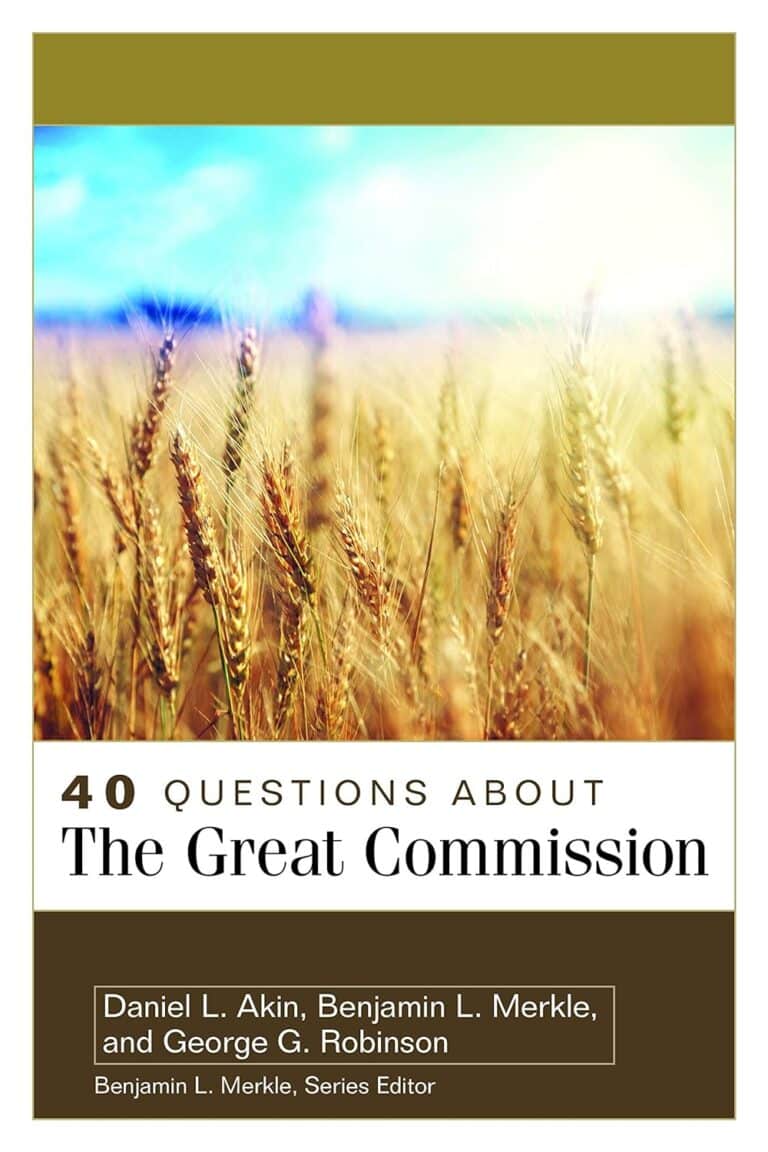
Ultimately, 40 Questions about the Great Commission is a reminder of what Jesus has commissioned his disciples to do. In the summary of the last chapter, Robinson writes,
In conclusion, Jesus’s famous last words contain a simple, but sacrificial command to make disciples of every kind of people in every place. But he couches that command between two very precious and powerful promises: (1) we join God on mission empowered by Jesus’s all-encompassing authority; (2) we join God on mission comforted by Jesus’s never-ending presence. (331)
I highly recommend this book for those who want to think historically, biblically, theologically, and methodologically about the Great Commission that all disciples of Jesus are called to play a part in. This is one of the best biblical studies books I have ever read. You may come to the same conclusion after reading it too.